The Framework for Web-Based Service-Oriented Architectures

2G framework is the name of the technology and the set of basic functions on which the applications developed through the GBuilder Suite production environment are based. These applications constitute the new technical and conceptual SOA (Service-Oriented Architecture) and RIA (Rich Internet Applications based on Web 2.0 interfaces) architecture proposed by Gesinf to the market, both for its own Enterprise-level applications and for third parties interested in developing or extending their software portfolio.
2G is an architecture primarily designed to provide a highly interactive user interface, within the new operational concepts known as Web 2.0 and Rich Internet Application, a technology that makes it possible to achieve a user experience on the web that is dramatically superior to that obtainable through traditional HTML/Web 1.0 applications, for which the level of interactivity has proven clearly insufficient for complex management systems, such as those normally used within organizations for the internal automation of business processes.
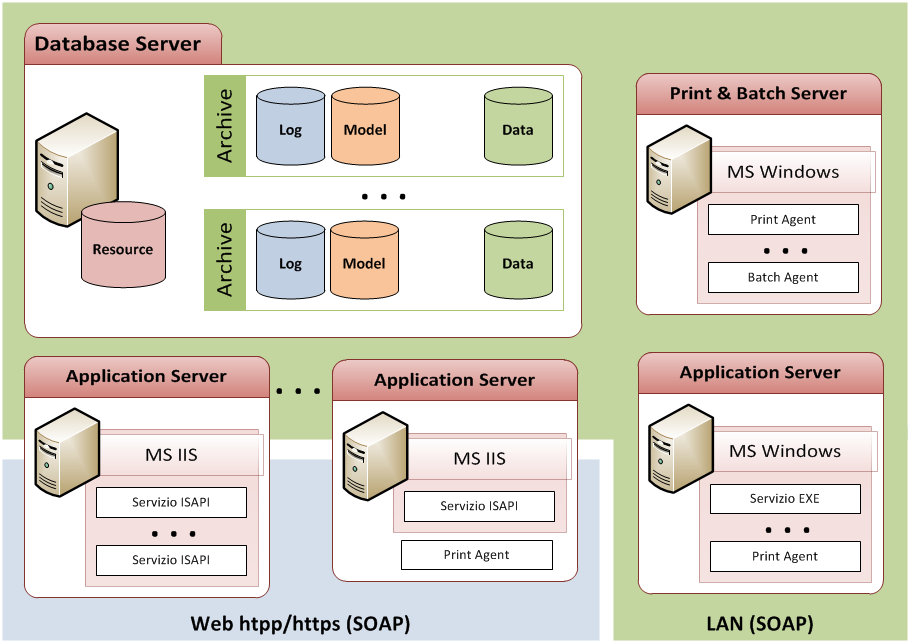
Together with an effective RIA interface, Gesinf has chosen not to compromise on the most suitable server architecture for managing complex business processes, such as those typical of ERP business systems, completely revolutionizing its solutions. The result is the implementation of a native SOA (Service-Oriented Architecture) architecture based on web services, currently considered the technological evolution point for management systems. Although the technical definition of SOA architecture is quite complex, the practical advantages it offers are very simple: the easiest and most efficient way to expose the functions and information contained in a given application to the outside world, for example to other programs, with maximum control and security. 2G applies this concept in the best possible way within its service-oriented architecture, using a separate application layer to isolate, manage and publish business objects externally; this layer represents a sort of external relations office for the system: the service layer (as it is called) provides the interface and external applications with a series of services to interact with business objects, translating received commands (methods) into data reading/writing activities according to the application rules. Neither Gesinf interfaces nor any third-party applications need to know the location or structure of the database and, above all, they can request information from the service layer about the structure of business objects and the methods available for their management, using a standard protocol independent of the hardware and software used: XML. Furthermore (and this is another advantage of the multi-tier structure), the user interface is completely separate and independent from the business rules, therefore it can evolve easily and independently from them or be easily integrated/replaced with other interfaces, even on different devices and operating environments. All this results in a so-called multi-tier or 3-tier architecture, namely a multi-layer or three-layer architecture, in which the third layer, the application server and its business logic, is placed between the two traditional tiers of client/server applications (database and interface).
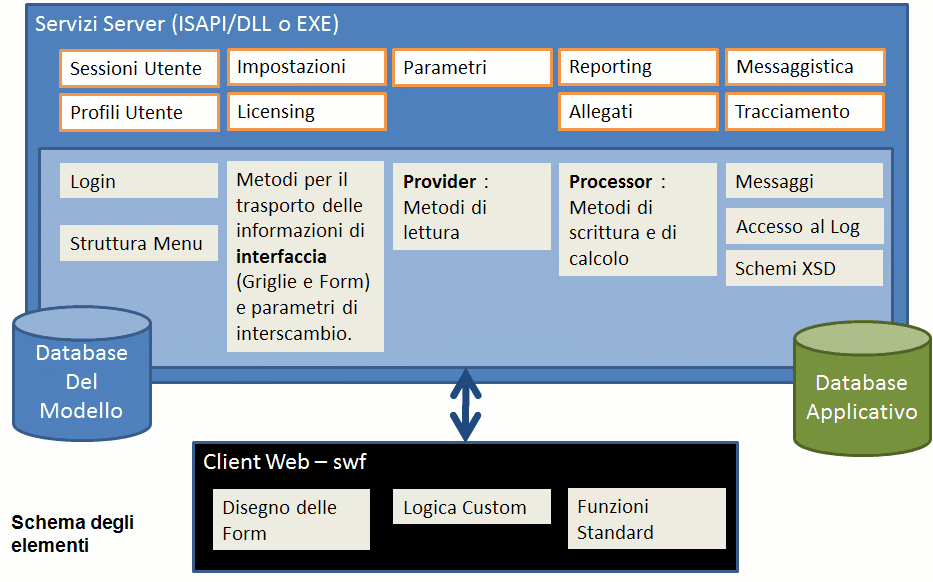
The aspects described above represent, however, only the advantage visible to the user; less evident is the drastic improvement in the software production process and the significant increase in software quality, thanks to the undeniable benefits in terms of functional and performance testing. In short: an architecture that makes it possible to provide more cost-effective, more reliable and more open solutions without having to sacrifice maximum operational efficiency and user experience.
Given the undeniable advantage of web services, many applications on the market provide “interface layers” as partial solutions, introduced into a traditional architecture to compensate for the lack of external openness. In the case of 2G, however, the SOA architecture is the solution itself, namely the only way in which the system makes its functionalities available, whether they are used by Gesinf software users through the RIA interface or by other applications (traditional or web-based).
Usage Scenarios and Benefits
2G offers a wide range of advantages, some of which are directly related to user operations, while others, equally important, concern the interoperability of applications with external software, as well as system administration, monitoring and configuration.
Web and User Interface
2G allows the web to be used through a feature-rich, multi-window and highly interactive user interface, representing a significant step forward compared to static web pages and their continuous refresh requirements. Applications are compatible with all internet browsers available on the market and do not undergo changes in appearance or layout when switching from one browser to another.
- The web without compromises
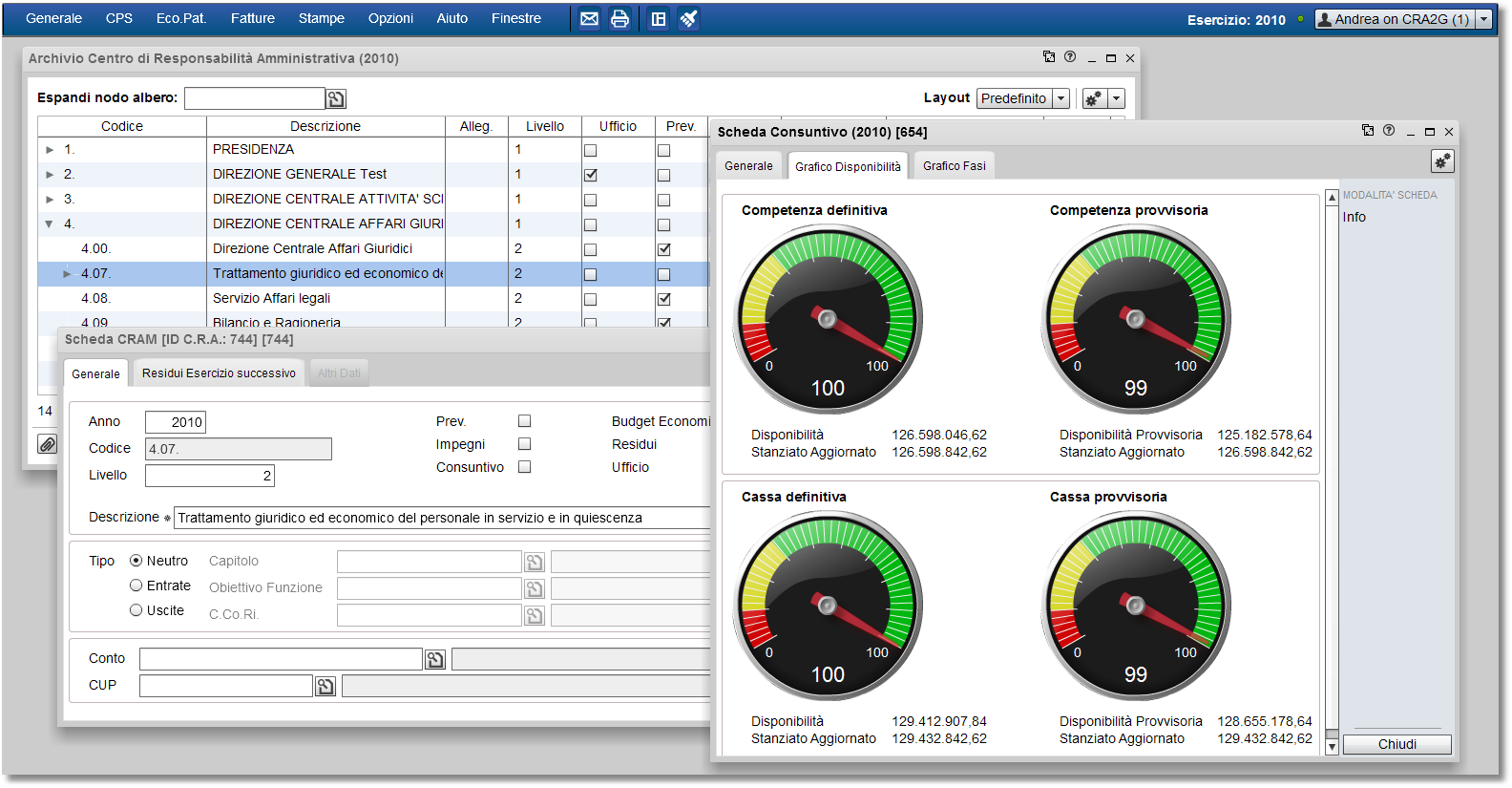
The exclusive RIA technology allows users to easily navigate within a multi-window system, similar to what happens in desktop applications, without the delays typical of web-based programs. Windows can be moved, resized, minimized, rearranged and overlapped using the classic tools of operating systems; access to sub-windows is immediate and, where useful, the foreground window prevents operations outside it, avoiding the risk of losing sight of the current workflow. Transparency effects, shadows and visual enhancements make the workspace organized, easy to understand and visually appealing. In addition, the system stores the size and position of windows as defined by the user, restoring them on subsequent accesses without the need for continuous adjustments; and when the workspace becomes particularly crowded, windows can be reorganized using the classic "cascade" and "tile" functions, features that are uncommon in web applications.
Powerful user tools
When managing large archives, 2G provides an interface that is even more powerful than the one already highly appreciated by users of the Team platform. In particular, within data management grids, which in this case display business objects, users can:
- Search data using any information contained in the archive and any condition.
- Create a personal library of display layouts, choosing which fields to view and in what order;
- Sort rows according to their own needs, including sorting by multiple fields;
- Create navigable data groupings based on the element defined by the user;
- Create personal data sets based on user selections (current data);
- Export data in MS Office format in real time.
- Reports and background activities
2G natively manages the execution of reports in the background. Users can continue working while a separate print server processes reports and makes them available as soon as they are ready, preserving the results for future consultation. This is an undeniable advantage, especially for reports requiring significant processing.
- No more expired sessions
The exclusive automatic session refresh system prevents web windows from expiring when they are not used for a certain period of time, as happens in most internet applications, while still preserving this feature in the event of an operator workstation crash or communication failure. For users, this means avoiding the risk of losing information entered after an operational pause; for system administrators, it means being able to know the actual status of connected users.
- Messaging
2G displays system messages asynchronously (without interrupting user operations) through a practical popup window interface and allows users or groups of users to exchange messages. Messages are delivered upon the first useful command executed by the user and remain available on a historical page for possible consultation at a later time.
- Customizable appearance and fonts
Each user can customize the appearance of the interface, including color themes, font type and font size, according to personal preferences and text visibility requirements. With the advent of large high-resolution monitors, this feature is particularly important for making daily operations more comfortable.
- Native electronic attachments
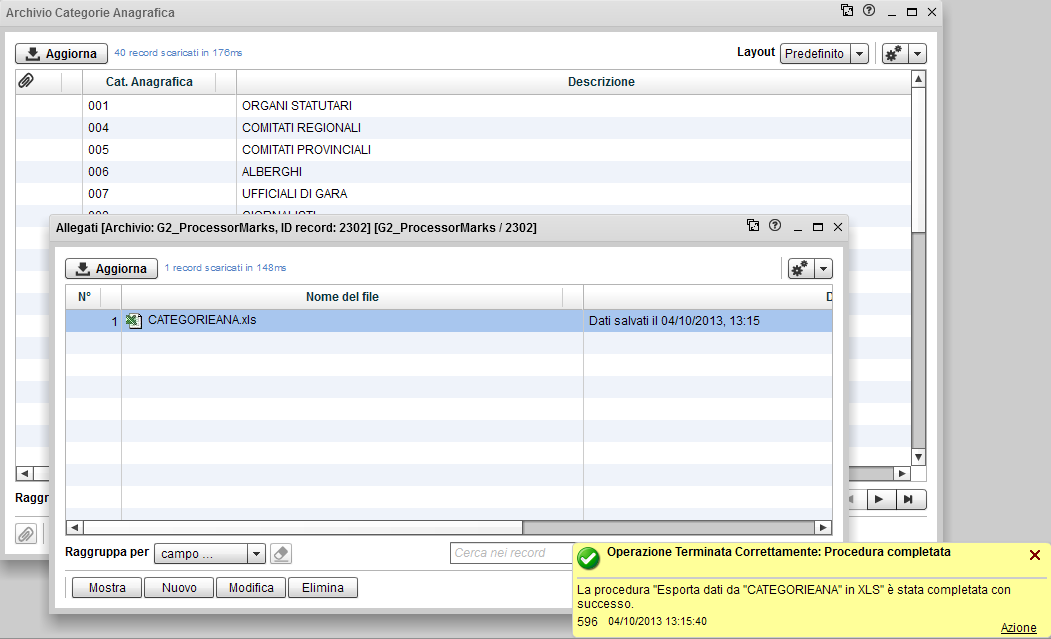
2G natively integrates features for managing electronic attachments associated with every application information item available in the system. Upload and download operations are immediate and take place through streaming services, ensuring extremely secure communication. Attachments can be stored in a separate database or separate storage system, making it easier for administrators to manage large amounts of data.
- Multimedia content in one click
2G natively integrates the ability to manage multimedia content, including photos, audio and video, directly within application data, through powerful streaming upload/download functions.
Performance and Scalability
As with the Team platform, particular attention has also been paid to performance in 2G when dealing with complex configurations, large numbers of users and high transaction volumes; however, in this case it has been possible to exploit the benefits of the multi-tier architecture, such as the ability to use multiple application servers in parallel and the capability to perform preliminary command processing in order to determine the best way to access the database. This represents a significant advantage, considering that an intelligent service can reduce the workload of the database server and network traffic by more than 90% compared to traditional client/server solutions.
- Transparent scalability for large installations
2G allows the use of multiple application servers in systems requiring higher performance, in environments with large volumes of data or transactions. Server scalability is immediate and transparent, with no configuration requirements, and the implementation of load balancing systems is particularly straightforward. Thanks to this technology, it is possible to guarantee optimal performance even with hundreds of users and millions of transactions.
- Optimized performance
A sophisticated multi-level cache system, active both on the server and on the client side, minimizes disk access and data exchange over the web. In addition, the search methods and the exclusive command simplification system allow the application server to optimize the workload on the database by retrieving and processing only the information required for the requested operations. Web activity is constantly represented by a virtual indicator on the client side, showing communication activity to and from the server; an effective tool also for verifying network availability and actual response times.
Monitoring and Debugging
The activity tracking system for data operations performed by 2G leaves no room for compromise. At the highest level of detail, it allows the complete reconstruction of commands sent to the application server and any information transferred to the Client. The ability to consult traces directly from the client, as well as to inspect the current properties of the represented objects, provides administrators with unprecedented control over the system.
- Global activity tracking
Thanks to its SOA architecture, 2G is able to store all activities performed by clients and external applications, both in terms of data writing and reading. Each activity, classified according to its category, is tracked with reference to all information needed to determine “when”, “who” and “what”; it is even possible to store every piece of information read, field by field, and the internal server states relating to requests, subject to enabling the relevant categories and availability of the required storage space. Activity history is maintained within a separate database, which can be subject to independent backup and periodic data clearing. Its consultation can be performed directly from client screens by users with administration rights. The recorded information also includes command execution time, making real-time performance monitoring possible.
The completeness and flexibility of 2G tracking allows the platform to be used even in environments where read access to data is a critical aspect, for example in environments managing monetary transactions or providing access to sensitive data.
- Access to internal information
System administrators can access internal program information directly by navigating through the application interface in profile mode; objects and their properties, whether or not derived from the business objects managed by the server, can be inspected in real time simply by clicking on web application screens, allowing users to view what the client is processing in real time. At any time, the system provides all the information needed to explore application objects and form parameters with a simple click.
Profiling and Configuration
The powerful user profile definition capabilities of the Team platform have been replicated and enhanced in 2G. Control is possible at the level of individual fields, labels or buttons, while in 2G it is possible to apply multiple profiles to a single user, interactively and through the exclusive profile mode.
- User Profiles at the highest level of detail
2G incorporates powerful tools for defining user profiles, settings that allow application behavior to be modified down to the level of individual objects. User profiles, including multiple profiles per user, can be defined in real time and guarantee a level of user rights customization comparable to the advanced profiling offered by Team solutions, which is virtually unique in the web-based ERP market. It is therefore possible to link the presence/absence of any element to a profile (for example menu items, individual screens or buttons) and the characteristics of individual business object fields (mandatory status, visibility, default value, etc.); rights automatically affect the read/write services of business objects and the way the interface is displayed, which from the user’s perspective is automatically “transformed”.
- Real-time definition of Rights and Restrictions
Thanks to the ability to inspect client objects in real time, administrators can define user profiles directly by interacting with the client interface. An easy way to restrict functions based on what is displayed on screen, without the need to navigate through hundreds of object and property names.
Openness to the External World
The adopted architecture, thanks to the standards used (SOAP XML) and the sharing of business object update rules, makes 2G the ideal solution for managing application interoperability in environments where reliability and monitoring of operations performed by external applications are important.
To learn more about 2G’s capabilities in managing external applications, download the information note: | Download |
- Consolidated standard for external access
2G communicates through a standard protocol independent of the database and external software and automatically provides online documentation regarding message formatting and the information available, which external software generally uses in an automatic and guided manner. Services are independent of any structural changes to the underlying database; therefore, third-party applications can base data exchange on self-documenting formats that do not affect operation as long as the information required by the service remains unchanged (this means, for example, that data exchange is relatively unaffected by technical database updates).
2G integrates business object update rules into the service layer and is able to verify that external calls are consistent with these rules before operating on the database. 2G can also transform received data before performing write operations, based on specific rules.
- Access configuration
Thanks to its advanced profiling capabilities, 2G allows rapid configuration of external applications in terms of rights and restrictions, in an easy and self-documenting way.
- Guarantees and responsibilities
Global access tracking makes it possible to fully monitor operations performed by external applications and to carry out historical analysis of executed transactions.
Administration and Maintenance
Standard and interactive tools make system administration simple and immediate.
- Application configuration
A dedicated management function allows administrators to monitor configuration parameter values through an interface that also provides the necessary online help for their definition. In addition, 2G enables administrators to constantly verify the status of active system licenses, based on digital certificates, and independently manage their allocation among the various users. The system also supports license calculation based on physical users, independently of the account, making it possible to provide multiple sessions or multiple accounts to the same user in departmental environments.
- Updates
2G retains the exclusive automatic update features of the Team family; installing new versions requires no technical intervention, and updates are immediately made available to system users through guided web-based download procedures.
![]() | The 2G framework presented at the ITDevCon European Delphi Conference 2011 for the development of Enterprise-level applications.
To download the information sheet.
| Download |
The 2G Framework project received funding of €233,485.00 as part of the investment programme financed by Sviluppo Lazio S.p.A., relating to Activity I.4 “Acquisition of advanced services for SMEs” under the POR FESR Lazio 2007-2013 programme. The project was submitted by the deadline of 7 July 2009 and approved by resolution dated 23/04/2010, published in Bollettino Ufficiale della Regione Lazio No. 31 on 21/08/2010.