
Tel.: 06 833.650

The evolution of public accounting towards managerial management

The official provisions and recommendations concerning public accounting and administration, issued in recent years, have gradually introduced into the administrations concerned the typical concepts of privately managed companies, adding the principles of economic-patrimonial accounting and analytical accounting to the traditional financial accounting system. The objective was, and remains, the improvement of the efficiency and effectiveness of administrative action, through the introduction of analysis and planning techniques aimed at optimizing costs and increasing overall management performance.

All this was achieved in 2003 with the publication of the Decree of the President of the Republic of 27 February 2003, no. 97 - Regulation concerning the administration and accounting of public bodies referred to in Law no. 70 of 20 March 1975 - which, repealing Presidential Decree 696/79 from 1 January 2004, became the new reference framework for public bodies in administrative matters.

The TEAM platform, already designed to meet the modernization requirements of public administrations, both in management and technological terms, fully incorporates the needs arising from the adoption of the new regulation, becoming on the one hand the ideal tool to allow the immediate adaptation of entities affected by the new directives, and on the other a user-friendly platform to guide them, in a sustainable manner, towards effective managerial management of the public organization.

Today TEAM Government, in its various configurations, is used in dozens of public administrations, privatized companies and No Profit organizations, achieving remarkable results in terms of user satisfaction, process standardization and response to the different requirements of planning, management and control.

The accounting records system, as well as the structure of financial statements and the analytical accounting framework, derive from the general system settings defined when the system is installed at the organization. However, TEAM’s distinctive ability to redefine its structural configuration through external parameters makes it possible to implement accounting systems of different types, based on state accounting, public accounting and related systems, or in compliance with specific administrative regulations, in almost immediate timeframes.

TEAM is in fact frequently adopted in application of decrees or regulations concerning the accounting and administration of public organizations of different types and operating in various sectors, including:

Autonomous Public Administration entities directly subject to the provisions of DPR 97/2003.

State bodies subject to special accounting systems, with control and auditing by the competent ministries (e.g. authorities).

Autonomous entities with ad hoc laws or decrees regulating accounting and administration, derived from traditional financial accounting (DPR 696/79) with specific exceptions or particular requirements in the maintenance of economic-patrimonial accounting (e.g. commissions of state bodies).

Autonomous entities not expressly subject to Presidential Decree 97/2003, equipped with their own independent administrative-accounting regulations inspired by general provisions such as Law 94/97, Legislative Decree 279/97, Law 208/99 (e.g. entities not included in the list referred to in Law 70/75).

Associations or entities with private legal personality pursuing public purposes, subject to civil accounting rules but with obligations regarding financial reporting and accounting records (e.g. pension institutions).

Companies created through the privatization of public entities, which still retain, entirely or only for specific activities, obligations regarding financial planning and reporting towards public bodies (e.g. joint-stock companies carrying out public utility activities under agreements with the State).

Central State Administration bodies (in the TEAM 3D version).

In all the cases described above, TEAM has demonstrated its ability to easily support all financial, economic-patrimonial and analytical management requirements, without the need for lengthy (and costly) structural or functional redesign activities, managing to cover, with virtually no code modifications, all the required administrative and accounting tasks.


Financial, Economic-Patrimonial and Analytical Accounting System

TEAM Government, even before being a software application, can be defined as an organic set of process rules, structures and methods for the management and representation of administrative-accounting data, incorporated into a single system for business automation, which constitutes the information layer on which accounting and non-accounting applications are based. The objective of the designers was not only to include in TEAM all the information and process rules required to achieve the global management system, making information available where needed, but also to provide a predefined standard for the processing and representation of such information, in order to make it available in the required form. The result is the overcoming of traditional concepts of relational databases and modular software, namely the creation of an immediately usable IT infrastructure, acting as a repository of information, process flows and tools required by the user organization for the evolution of its administrative management, with extensive adaptability to different organizational realities.

To make all this possible, the TEAM platform was designed around a threefold nature: public-sector financial accounting, business-oriented economic-patrimonial accounting, and analytical accounting. The real strength of the platform lies precisely in this threefold nature, which allows each operation to be viewed and processed according to the three different accounting systems, while simultaneously supporting management control requirements.

This is a key aspect in assessing the potential of the TEAM platform, making it, to date, the only E.R.P. (Enterprise Resource Planning) system not directly derived from software solutions designed for private companies or local authorities, but conceived exclusively for public administration.

The application is based on the unified general database, composed of the information layer of financial and economic-patrimonial accounting, on which common functions operate. These functions, defined in terms of processes, operate across the entire information layer, forming on the one hand the basis for the preparation of the financial budget and final accounts and, on the other, the recording of double-entry accounting operations for the preparation of business-style financial statements and cost analysis. Both accounting systems are considered within the reclassification criteria for analytical accounting, carried out on the basis of three distinct elements: Administrative Responsibility Centers, Cost Centers and Resources (projects), Objectives/Functions.

The key aspect of the overall system is its ability to convert operations arising from public accounting processes (commitments, assessments, payment orders, etc.) into elements that can be processed through double-entry accounting, faithfully and uniquely reproducing their structure and meaning, without requiring additional linking information to be entered by the user from time to time. All this while ensuring that analytical accounting elements, regardless of their structure, are also handled uniquely by the system.

TEAM solves this issue by applying a series of integration “rules” within unified processes, rules resulting from extensive knowledge of the fundamental principles of the two accounting systems involved. The reliability of these integration rules is demonstrated by their relative simplicity, achieved through a study based on the principle of minimizing conceptual complexity. The result is a truly integrated system, effectively capable of producing the two parallel financial statements jointly, without disrupting the operating methods of the public entity, but only by adding a minimum amount of information or, rather, by achieving greater rationalization of information already normally available.

A demonstration of the great potential of these process rules is the ability to generate the statutory financial statement (prior to adjustment and integration entries) almost automatically, based solely on the financial operations recorded during a given financial year, without the need to review each individual transaction. This is an uncommon feature when compared with most integrated systems available on the market, whose correct operation depends, entirely or partially, on the different methods used to enter accounting records at the time of their initial recording.


Multi-dimensional Budget Management

The flexibility of the logical and functional structure of financial statements is one of the most important features of TEAM. It allows the creation of customized structures not only for the financial budget chart of accounts and the economic-patrimonial chart of accounts, but also for the logical and operational links between these and the analytical elements plans, ensuring an almost unlimited level of customization. The management system is based on the presence of five distinct budget dimensions (generically referred to as "charts of accounts"), independent as regards their definition, but interdependent as regards their processing and reporting methods:

  • Financial Units (Chapters, the basis of forecast units)
  • Administrative Responsibility Centers
  • Functions - Objectives
  • Cost Centers and Resources
  • Economic - Patrimonial Accounts

Each Chart of Accounts can contain an undefined number of levels, with branches of variable depth; each level, separately for each branch of the relevant chart of accounts, may be considered necessary for financial and/or economic forecasting purposes, for cross-referencing with other budgets, or useful only for final assessment purposes from a financial and/or economic perspective.
The following provides an example of a configuration relating to the use of budget and analytical items, among thousands of possible combinations.
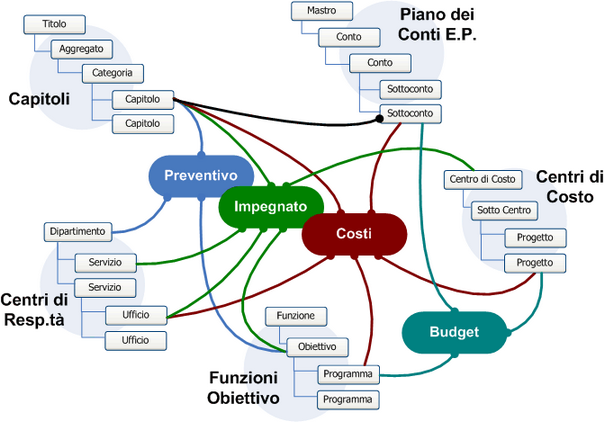
The configuration of the example shown in the diagram is as follows: in the financial budget, chapters (4th level), 1st-level Administrative Responsibility Centers, and functions-objectives (2nd level) are involved; with regard to committed amounts, the responsibility centers are detailed up to the service level (2nd level) in some cases, and up to the office level (3rd level) in others, together with cost centers (1st level) and functions-objectives (2nd level, as in the budget); for cost calculation, projects (3rd level of cost centers), programs (3rd level of functions-objectives), offices (3rd level of responsibility centers), as well as economic sub-accounts are involved; the budget is obtained by cross-referencing projects and programs for each economic sub-account. It is important to emphasize that the number of available levels and the terms used for each element are entirely at the discretion of the organization.

Thanks to this extreme flexibility, TEAM significantly extends the analysis and reporting capabilities available to the organization, based on Administrative Responsibility Centers, Cost Centers and Functions - Objectives, organized on a single level or on multiple levels, with each level potentially having a different meaning in terms of constraints and reporting characteristics.

For example, with reference to DPR 97/2003, TEAM can be configured as follows:

  • The basic forecasting units are defined through the intersection between the Administrative Responsibility Centers (at one or more subordinate levels) and the financial chart of accounts, composed of the levels Title – 3rd-level UP (aggregate) – Category – Chapter, the latter being used for availability control in the management budget. The UPB can however be extended with sub-levels (e.g. sub-chapters or items), which can be used both for the formulation of a binding forecast with greater detail and simply for more detailed end-of-period reporting, relating to expenditure or revenue.
  • It is possible to include functions - objectives within the UPB, with these also organized on multiple levels (e.g. activities, programs, projects). The various related levels can be used to constrain expenditure, to report it starting from the financial perspective, or to obtain a statement of final costs.
  • The economic-patrimonial chart of accounts (economic forecast and final statement) is entirely definable by the user, with an unlimited number of levels; it is uniquely related to financial accounts (chapters or lower levels), and automatically linked to Administrative Responsibility Centers and functions-objectives.
  • The cost centers, also organized on one level or multiple subordinate levels, on which the economic budget is created, are automatically integrated into financial management, for elements deriving from it, and into economic-patrimonial management, in order to guarantee constant alignment. The presentation of forecasts and results of cost centers takes place according to an aggregation table of economic items, definable by the user, in relation to the structure of the economic-patrimonial chart of accounts.

Based on these settings, the system is able to adapt its own functionalities, whether related to control functions, input screens or reports. For example, the system will be able to:

  • Allow the preparation of the management forecast budget, the decision-making forecast, the economic forecast and the cost center budget, starting from a single entry of the individual detailed items, automatically and transparently processing the official statements.
  • Modify information requests in commitment/assessment screens and in the other expenditure and revenue phases, in order to ensure the retrieval of the correct information for each phase (i.e. the correct level for each accounting element).
  • Modify the data required in budget variations, consistently with the settings described above, in order to make them consistent with the financial forecast.

The system is also able to self-configure if one or more analytical charts of accounts are not used (for example Administrative Responsibility Centers or functions-objectives), while preserving the consistency of the information required and represented in the various operational phases. It is also able to manage changes in the structure of charts of accounts from one financial year to another, through the input of the minimum possible amount of reconciliation information.

Through the settings of the charts of accounts, TEAM is able to produce all the statements required by regulations for the presentation of the forecast budget and the final accounts. In particular, the preparation of the financial and economic forecast follows these methods:

  • The Statement showing the presumed administrative result is automatically calculated, for the part obtainable from the data available in the system, with manual integration of presumed values.
  • Entry within a single management process of the financial allocation (for competence, estimated residuals and cash) and the economic budget at the maximum level of detail, represented by the possible forecast combinations of the items contained in the various charts of accounts. In this sense, financial management, with regard to decision-making and management budgets, is actually managed together with the economic component, represented by the cost center budget and the economic forecast. The presence of financial constraints also based on economic items allows effective expenditure control, considered within the internal control system, and enables constant consistency between the two different accounting systems and analytical accounting.
  • Automatic printouts of forecast and final statements obtainable from the data available in the system are provided: general summary statement of financial management, final administrative statement.
  • The financial report (decision-making and management), the income statement, the balance sheet, the cost center final statement and any table structured by functions - objectives, are automatically generated according to the formats required by regulations.

The structure and functions described above represent only the standard settings (essential) for management under DPR 97/2003; however, the numerous functions and customizations available in the platform can be used to extend the level of budget control and analysis. An example is the possibility of defining cost centers as elements of both economic accounting, as required by regulations, and financial accounting, at forecast or final stage, thus extending control capabilities and making management constraints possible, which are essential in many medium and large organizations.

Finally, it is worth highlighting the reconciliation statements between financial accounting and economic-patrimonial accounting, relating to the composition of receivables/payables and the economic accruals of operations deriving from financial movements, which are essential for demonstrating the balance between the two accounting systems.

Also with regard to the application of D.P.R. 97/2003, the accounting system fully complies with the provisions of the regulation. For financial operations it provides:

  • assessment ledger, containing the initial allocation and subsequent variations, assessed amounts, collected amounts and amounts remaining to be collected for each revenue chapter;
  • commitment ledger, containing the initial allocation and subsequent variations, committed amounts, paid amounts and amounts remaining to be paid for each chapter;
  • residuals ledger, containing, by chapter and year of origin, the balance of residuals at the beginning of the year, collected or paid amounts, positive or negative variations, amounts remaining to be collected or paid;
  • chronological journal of collection orders and payment mandates.
  • For economic operations, the system is based on the double-entry general ledger, from which financial statements (partial or general), account ledgers and reconciliation statements with the financial budget are derived.

Electronic brochures

The information material on TEAM is available in PDF format. The files can be downloaded to any folder; to view them, simply click on the file name, which has the .pdf extension.

Click to download the TEAM Government brochure:

It contains a description of the architecture and the platform specifications, with reference both to the system configuration for the application of Presidential Decree 97/2003 and to related regulations.

Download (1.6 MB)

Click to download the brochure of TEAM Government Additional Modules

Download (1.1 MB)

To view documents in PDF format, you need Adobe Acrobat Reader v.7 or later, which can be downloaded free of charge from the manufacturer's website by clicking on the icon.


TEAM Government - Demonstration Videos

From this area it is possible to access the demonstration videos of Team Government, using a multimedia player capable of supporting the mp4 standard (native on MS Windows Vista, 7 or 8). For other operating systems, the VLC shareware player can be used. Access is allowed only to registered users. If you have a valid account, click the Download button to open the videos.

Entering a Budget Commitment Reservation

Download

Entering Commitment and Allocation

Download

Entering Supplier Order and Procurement Cycle

Download

Entering Supplier Invoice

Download

Payment Order Registration Phase

Download

Final Issuance of Payment Orders and Bank List

Download

Generation of Electronic Data Transmission File

Download

Automatic and Manual Journal Entry

Download

Budget and Financial Forecast Entry

Download

Budget Variations

Download

Financial Budget Variations

Download