



Usage Scenarios and Benefits
The typical usage scenario for neTAX is represented by the presence, within a single organization, of multiple management applications, which may be located partly within the same LAN and partly in remote areas. These applications, potentially developed by different vendors using different technological tools, may have their own master data archive, with the resulting need to align shared data, or they may directly read and/or write shared information. It is also common for one or more applications external to the accounting system to process information with tax or accounting relevance, and therefore require a standardized and monitored access point to such information.
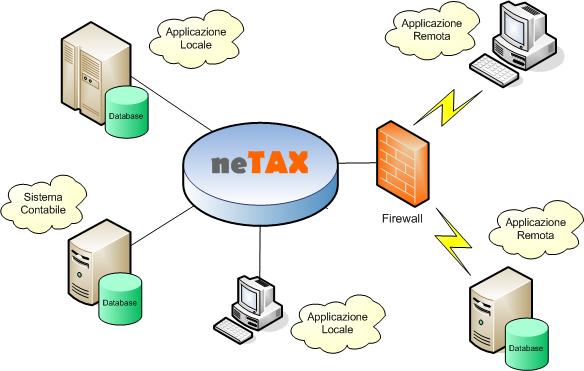
In these contexts, neTAX is the ideal tool for implementing a solid information-sharing infrastructure, based on a series of predefined services and processes valid for all applications and specifically designed to effectively address issues related to security, monitoring, and master data management.
Thanks to its SOA architecture, neTAX is able to expose all the functions required for reading, writing, and synchronizing data.
The aspects addressed and solved by neTAX are numerous, and the following list is only an extract of the benefits that the platform can offer in any of the scenarios considered:
- Standardize data integration procedures and methods, thanks to the ability to provide all interested software vendors with the same logical exchange protocol, the same data structures, and the same implementation rules.
- Provide easy, immediate, and secure access to all applications both in local and remote environments, through the use of the widespread HTTP/SOAP standard, self-descriptive and native in most software development environments currently in use, and particularly suitable for environments with constraints and restrictions in terms of IT security.
- Isolate data update and consultation responsibilities, thanks to constant monitoring of operations performed by individual applications/users and to the detailed list of all activities carried out on data, including reading activities.
- Limit access possibilities, even in read-only mode, for each application, as it is possible to define the information each application is responsible for, down to the individual data item.
- Manage the various applications, users, profiles, security, system downtime, and crash recovery through the platform tools.
- Drastically increase the reliability of shared data, thanks to the exclusive transaction management technique provided by neTAX through persistent sessions, an absolutely innovative technique in the SOAP environment and more generally in environments based on remote services.
- Effectively manage concurrent access to data, thanks to advanced lock management and data ownership identification mechanisms, based on the exclusive logic of candidates, subscriptions, and exclusive areas.
- Easily synchronize archives, resolving conflicts caused by updates performed at different times by multiple applications, through revision dates (reviewdate) and data check-in functions.
- Extend the content of shared data to information of different types and origins, thanks to the ability to implement new collections using the access standards already defined.
In scenarios involving the sharing of tax-related information among multiple applications, with particular reference to withholding tax payments and obligations related to the withholding agent, neTAX represents the ideal solution for definitively resolving long-standing issues concerning the correct maintenance of records and reporting activities (above all, the preparation of the 770 tax form). In this context, neTAX allows:
- Feeding a single payment archive, through the use of predefined categories (payment classes) already capable of correctly validating and calculating the tax, social security, and welfare components. Payment classes are defined and updated by Gesinf, relieving the customer from the need to keep them aligned with current regulations.
- Performing validation and preventive calculation of tax data and consistency of individual payments, allowing third-party applications to verify amounts and tax treatment before registration in the archive.
- Keeping online the totals reached compared to the amounts paid for compensation subject to tax and social security treatment linked to the achievement of thresholds (for example, occasional collaborator payments), which the system considers for payment calculation and validation; the system is also natively capable of taking into account self-certifications provided by subjects for tax and social security exemptions.
- Standardizing basic tables, such as nationality, region, province, and municipality tables within the various applications, thus avoiding unnecessary and costly reclassification activities afterwards.
- Obtaining summary data for tax and social security declarations, for the payment of related obligations; data for printing annual certifications; and the electronic transmission flow for the annual declaration according to the 770 form (also applicable to the new monthly 770 obligation introduced from 2008).
The benefits listed above represent only the main advantages offered by the use of neTAX, which provides a wide range of tools useful for facilitating the maintenance of a single master data system, such as automatic functions for calculating and validating tax codes, or the ability to lock data by multiple applications in order to prevent modification after its use for official reporting.