



Budget
Within the context of business operations, the budget is an important operational tool for business management, whose function is to identify and monitor the expected economic result in relation to revenue estimates and cost planning, as well as to define management responsibility levels and objectively evaluate the achievement of assigned objectives.
Statutory accounting, however, is by nature an exclusively final accounting system, whose purpose is to record transactions that involve economic and/or financial changes after they have occurred. Nothing is regulated regarding the presence of an economic budget and the authorization and control functions that constitute its essential elements for proper management (spending decisions, expected and authorized obligations). These so-called management aspects are therefore left to the free discretion of companies, which may adopt any budgeting and management control system they consider useful for their purposes, depending on the size and organizational structure of their activities, not necessarily integrated with the accounting system. With the introduction of the economic budget as a regulatory obligation, together with the related reporting requirements, the management model can no longer disregard the adoption of a management system based on extra-accounting records for its definition and formalization, the monitoring of availability and the authorization of expenditure, more or less binding, which anticipates accounting entries and enables the decision-making process underlying spending decisions. For operational reasons and due to the timing associated with decision-making processes, it is certainly useful for such a management system to be integrated with the accounting system, from which it must obtain the data required to determine actual economic balances in real time, and to be able to directly feed the accounting records by providing suitable functions for the creation of economic and financial statement entries.
To enable the full implementation of these principles, Corporate 2g is based on the presence of a formalized economic budget which, due to the requirement for predefined analytical elements, such as missions/programs, and the opportunity to operate according to management choices before accounting choices, is structured as an economic-analytical budget, i.e. based not only on economic accounts but also on one or more analytical dimensions that can be easily reclassified. The choice of adopting a sufficiently flexible multi-dimensional structure was designed to avoid introducing particular complexity into operational management, while remaining structural and ensuring the necessary increase in planning and monitoring capabilities, in line with the management and regulatory requirements of modern organizations.
A further aspect arising from the introduction of the economic budget and the related management elements is represented by the influence of asset-related operations on spending decisions and, ultimately, on operating costs and expected profit. Since the acquisition or disposal of fixed assets has an economic impact that cannot be directly compared with the economic forecast for the financial year and the related available resources, a system designed to provide spending monitoring and control tools cannot disregard the presence of an investment budget, namely a budget that defines or at least highlights, within a formalized decision-making process, the constraints on financial operations that will generate costs and revenues.
In this way, every management event is evaluated by the budgeting system, which provides the necessary tools for availability verification, making it possible to control expected and achieved results, regardless of the nature of the accounting information.
The overall software architecture is therefore designed as shown in the diagram below:
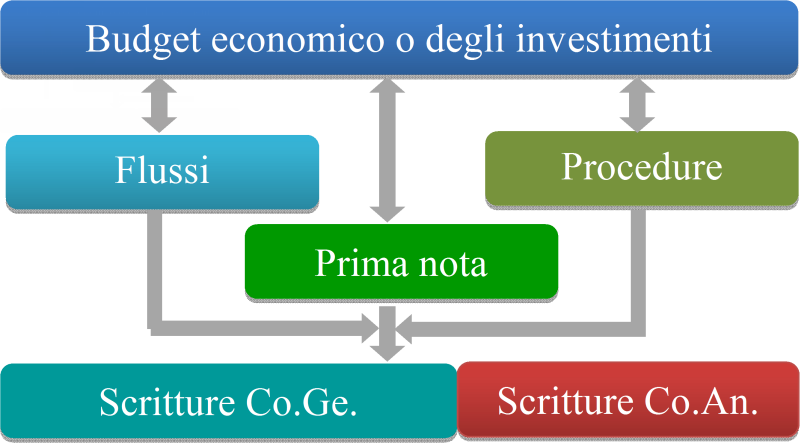
The economic and investment budget, respectively structured on economic-analytical and asset-analytical elements, constitutes the starting point for estimating the expected operating income, economic and financial planning, and compliance with the regulatory constraints introduced by Ministerial Decree 27/03/2013.
It is necessary to highlight that the structure of the economic-financial statement chart of accounts may provide, for management and/or internal control purposes, levels of detail higher than those envisaged in the standard chart of accounts. This has introduced the need to define economic and investment budgets consisting of account aggregates, in which each detailed account is not subject to its own spending limit but to the overall budget of the detailed accounts belonging to the aggregate. In the system, this possibility is managed through the introduction of a separate aggregate structure, defined as “expense items”, which reproduces the structure of the standard budget by including multiple detailed accounts; the movement of these accounts is reflected within the availability of their respective expense item.
With regard to the multi-year budget, from an architectural point of view it is represented by allocations assigned to the elementary budget unit for subsequent financial years; specific functions allow the “transfer” of extra-accounting, accounting, economic and asset-related information to the following financial year, in order to facilitate user operations and ensure the consistency of information across financial years.
Analytical Accounting
An essential aspect of Corporate 2g is its ability to manage analytical accounting through the presence of distinct analysis dimensions, which can be used during budgeting, analysis and reporting phases. The analytical dimensions have been designed to be used and structured according to the specific needs of the organization, for planning and control purposes, also considering the need for reclassification according to the Mission/Programme structure introduced by regulations, and for obtaining the reference database required for the creation of performance indicators, also required by legislation. The analysis of the requirements of different organizations and measurement needs has shown that the number of useful analysis dimensions for analytical accounting consists of three structures, which may be implemented either all together or only partially:
- A dimension relating to the organizational structure, understood as departments, offices, responsibilities, etc. This dimension, in the following sections and in the prototype, is referred to as Responsibility Centres (CRA).
- A dimension relating to production lines/business areas, in order to perform product/service cost analysis and the corresponding revenues. The term used below is Cost Centres/Revenue Centres.
The flexibility of the logical and functional structure of analytical accounting has therefore become one of the basic requirements of the system. It allows, in fact, the creation of a customized structure not only for the expense items plan - the aggregates of economic and equity accounts for investment budgeting purposes - but also for the definition of the logical and operational relationships between these elements and the analytical element structures, ensuring a high level of customization and adaptation to the organization’s requirements. In particular, all the structures involved, namely the chart of accounts, expense items and analytical structures, can accommodate a potentially unlimited number of levels, with branches of variable depth; each level, separately for each relevant branch, can be considered for the purposes of the economic and investment budget, through cross-reference with other analytical elements, or may only be useful for final evaluation purposes in terms of committed expenditure or actual costs incurred. The chart of accounts itself, which constitutes the information core for financial statement management, also has a completely user-definable structure in terms of both the number of levels and their content.
The management system is therefore based on the presence of four budget dimensions (generically referred to as “account plans”), independent as regards their definition, but interdependent as regards budgeting, processing and reporting procedures:
- Expense Items (structure obtained through aggregation of financial statement accounts);
- Cost Centres;
- Responsibility Centres;
- Objectives/Functions
The terms adopted above may be modified within the platform in order to adapt them to the terminology used by individual organizations, while maintaining their essential meaning as budget and/or final analysis dimensions.
The following section provides an example configuration relating to the use of budget and analytical items, among thousands of possible combinations, showing how users have complete freedom to define the role of the individual management plans and their respective levels within the various management phases.
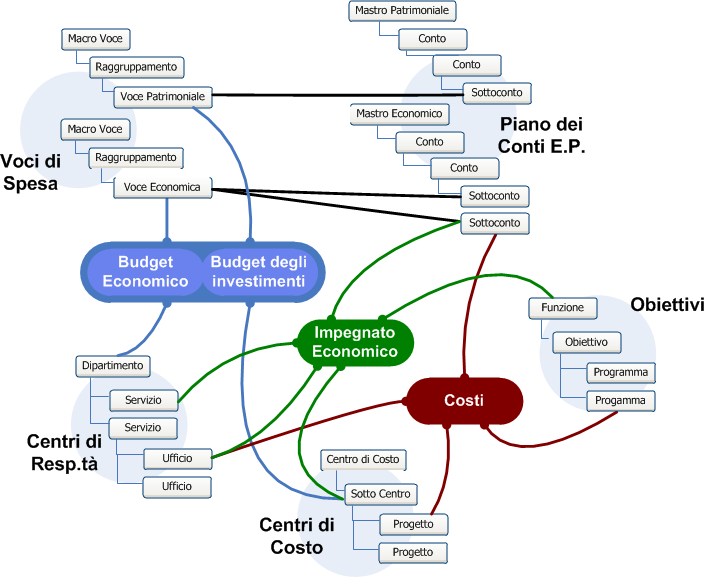
Based on simple settings, the system is able to adapt its functionalities within the management cycles, in particular it ensures:
- The preparation of the economic and investment budget, starting from a single entry of the individual detailed items, generating the official reports automatically and transparently;
- The adaptation of the payables/receivables cycle screens and, more generally, of the administrative flows, relating to the expenditure phases, as well as the phases involving the entry of the double-entry bookkeeping journal entries, in order to correctly retrieve the information required for each phase;
- The adaptation of the data required for budget variations (economic and investment), in accordance with the settings described above;
- The generation of financial statement reports both from the general accounting perspective - income statement and balance sheet - and from the analytical accounting perspective - the analytical income statement.
The system is also able to self-configure when one or more analytical account plans are not used, while maintaining the consistency of the information required during the various operational phases. The possibility of managing changes to the structure of the account plans and analytical elements from one financial year to another has also been provided, by entering the minimum amount of reconciliation information required, taking into account the evolution of analysis and management control requirements to which users are frequently subject.
Furthermore, in organizations where access by users or groups of users is differentiated according to “budget sections”, as in the case of departments, institutes or responsibility centres with operational autonomy, the system can discriminate based on analytical structures, allowing management partitioning to be achieved both from an operational and reporting perspective, also within a “hierarchical” view of the budget.