



Economic, Financial and Analytical Accounting System
TEAM NP belongs to the TEAM family of applications, the application platform for business automation, which provides the information layer supporting both accounting and non-accounting applications. In TEAM, the process rules required to achieve the overall management system make information available where it is needed and, through standards for the processing and representation of such information, in the way it is required.
To enable the full adoption of economic-equity accounting principles, based on the income system, within organizations where income is primarily useful for determining financial balance and operational equilibrium, TEAM NP has been designed with an architecture that allows differentiated input of accounting records: through process functions, namely workflow management, and through accounting journal entries. In both cases, and this represents one of the specific features of TEAM NP, the management system is based on the economic-analytical budget and the investment budget, which maintain their validity regardless of the method of data entry.
In this way, every transaction is evaluated by the budgeting system, which provides the necessary tools for availability checks, making it possible to monitor expected and achieved results, regardless of the origin of the accounting information:
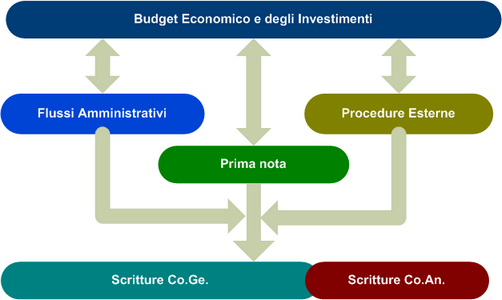
The key aspect of the system is the presence of process operations similar to those found in a public-sector accounting system, such as commitments (provisional and definitive), but managed from an economic perspective and linked to administrative workflows that generate accounting records based on actual management events. Administrative workflows and manually entered double-entry journal records are part of a single information network that is constantly compared with the budget through a set of simple and effective rules. All this takes into account analytical accounting elements, organized according to a multi-dimensional structure, which are also managed within the framework of the budget, administrative workflows and accounting records.
This architecture makes it possible to overcome the structural limitations of statutory accounting in terms of planning and control capabilities, considering that such accounting was not originally designed for these purposes. What represents merely extra-accounting information in traditional administrative systems based on business accounting principles becomes, in TEAM NP, an integral part of the accounting system, consistent with global management principles, allowing financial statements to be maintained according to the principles of transparency and rigor required by organizations with public-interest purposes.
Furthermore, the ability to import or link information external to the system, placing it within the correct context of management cycles, allows the platform to effectively manage both extra-accounting and accounting data originating from third-party systems, without resorting to artificial or temporary structures, and above all under the constant reference framework provided by the budgeting mechanism.
The multi-dimensional management of the budget
TEAM NP is based on a unified general database, consisting of the information layer of general accounting and analytical accounting, on which the application functions operate. Analytical accounting is based on the interdependence of three distinct analysis dimensions, which can be used and structured according to the specific needs of the user: Cost Centers, Expense Centers, Projects (projects).
The flexibility of the logical and functional structure of analytical accounting is one of the most important features of TEAM NP. It allows not only the customized construction of the budget item structure, which represents aggregates of economic and balance sheet accounts (the latter for investment budget purposes), but also the definition of the logical and operational relationships between this structure and the analytical elements, ensuring an almost unlimited level of customization.
The management system is based on the presence of four budget dimensions (generically referred to as "charts of accounts"), independent in terms of their definition and interdependent in terms of budgeting, processing and reporting methods:
- Budget Items
- Cost Centers
- Expense Centers
- Projects
The Cost Center and Project structures can contain an unlimited number of levels, with branches of variable depth; each level, independently for each branch of the relevant chart of accounts, can be considered necessary for the purposes of the economic and investment budget, for cross-analysis with other budgets, or useful only for final evaluation in terms of committed costs or actual costs. The list of expense centers, by its nature, consists of a single level.
The chart of accounts itself, which represents the information core for budget management, has a completely flexible structure, both in terms of the number of levels and their content.
The following section provides an example of a configuration relating to the use of budget and analytical items, among thousands of possible combinations, highlighting how the user is completely free to define the role of individual management structures and their respective levels within the various management phases.
Furthermore, in departmental management environments, user or user group access can be based on analytical budget structures, allowing management partitioning both from an operational and reporting perspective.
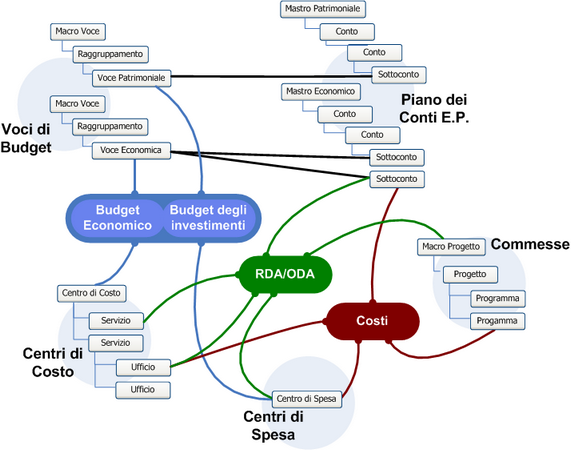
The configuration of the example shown in the diagram is as follows: the economic and investment budget includes budget items (3rd level), which aggregate economic and balance sheet accounts, 1st-level cost centers and expense centers; with regard to the RDA/ODA cycle, cost centers are detailed down to the service level (2nd level) in some cases, and down to the office level (3rd level) in others, together with expense centers and projects (1st level); cost calculation involves offices (3rd level of cost centers), programs (3rd level of projects), projects, as well as the sub-accounts of the economic budget. It is important to emphasize that the number of available levels and the terms used for each element are entirely at the user's discretion (except for expense centers, which retain their specific meaning).
Thanks to this extreme flexibility, TEAM NP significantly extends the analysis and reporting capabilities available to the organization, based on organizational units, Cost Centers and Functions/Objectives, which can be structured on a single level or on multiple levels, with each level having a different meaning in terms of constraints and reporting characteristics.
Based on these settings, the system is able to adapt its functions, whether related to control features, data entry screens or reports. For example, the system is able to:
- Enable the preparation of the economic and investment budget, starting from a single entry of the individual detailed items, automatically and transparently generating the official reports.
- Modify the information requirements of the administrative workflows, with regard to expenditure phases, as well as during the entry phases of the double-entry accounting journal, ensuring the retrieval of the correct information for each phase.
- Modify the data required for budget variations (economic and investment budgets) in accordance with the settings described above.
- Obtain financial statements (income statement and balance sheet) from the general accounting perspective, and the analytical income statement from the analytical accounting perspective. All reports generally used in economic and balance sheet accounting are also available, such as account ledgers, sub-ledgers, and the general journal.
The system is also able to self-configure if one or more analytical charts of accounts are not used (for example, projects), while maintaining the consistency of the information required and represented in the various operational phases. It is also able to manage changes to the chart of accounts structure from one financial year to another, through the entry of the minimum possible amount of reconciliation information.
The Authorization Workflow (Procurement Cycle)
In TEAM NP, expenditure operations can be carried out through successive authorization, recording and payment phases, within what is defined as the expenditure cycle. An important feature of TEAM NP is the ability to define in advance for which types of expenditure it must be possible or mandatory to use the expenditure cycle, namely for which items it is not possible to intervene directly on accounting records without going through the authorization workflow. This makes TEAM NP extremely flexible and adaptable to the actual organizational needs of the entity, allowing differentiated treatment of transactions according to the importance that the authorization and control process has for them.
For example, it is possible to require the organization to go through the preliminary phases of purchase request and economic commitment (RDA/ODA) and recording (documents) for expenditure items relating to the purchase of goods and services, assuming that these are subject to specific authorizations, while the direct recording of costs deriving from mandatory operations, such as financial charges, can be carried out outside the cycle, namely directly through journal entries.
For the operations included within the cycle, TEAM NP provides the following elements:
1. Purchase Requests (RDA, generally supply requests)
2. Purchase Orders (ODA, generally obligations towards third parties)
3. Documents (invoices) and delivery/service completion certificates (accounting records)
4. Payment Instructions
The elements indicated constitute the different phases of the procurement cycle and represent optional operations. The following diagram shows the main relationships between the phases and their impact within the accounting system.
It is important to emphasize that the indicated phases can be managed according to a specific preparation and authorization model, based on the organizational structure of the entity and the permissions granted to each person involved. In this way, it is possible to define the authorization workflow for the various documents and establish the relationships between the different offices.
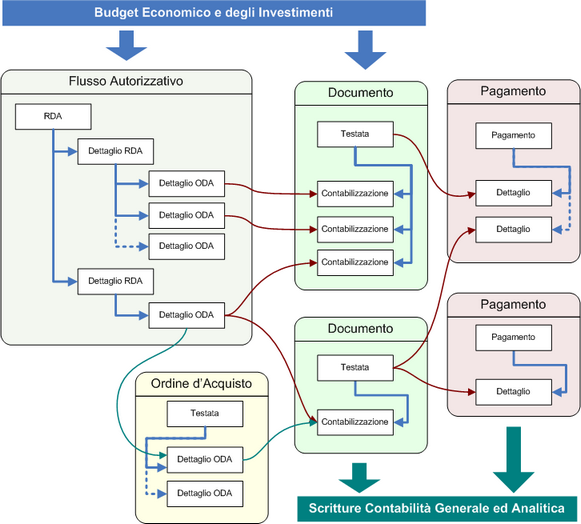
The diagram shows the various expenditure phases in relation to their meaning within the standard supply of goods and services processes, and clarifies that:
- Each RDA can consist of one or more details (products/services).
- Each ODA, consisting of multiple detail lines, can refer to one or more RDA details.
- A document (e.g. an invoice) can record costs relating to multiple ODA details; each ODA detail can generate accounting entries on different documents.
- Each payment instruction can settle one or more documents; each document can be paid through different payment instructions.
The potential of TEAM is expressed above all in the completeness and flexibility of the functions relating to daily operations, functions that allow the customization of the entire information flow of the organization, from budgeting to the reconciliation of the final financial statements.
The mandatory or optional nature of the available functions, as well as their availability, are defined during the initial configuration phase, together with the required level of operational automation.
The central elements for defining the workflow model are represented by the journal entry codes (and the corresponding network of payment codes), whose use, in addition to describing the accounting meaning of the various operations, determines the constraints and obligations reserved for the specific processing.